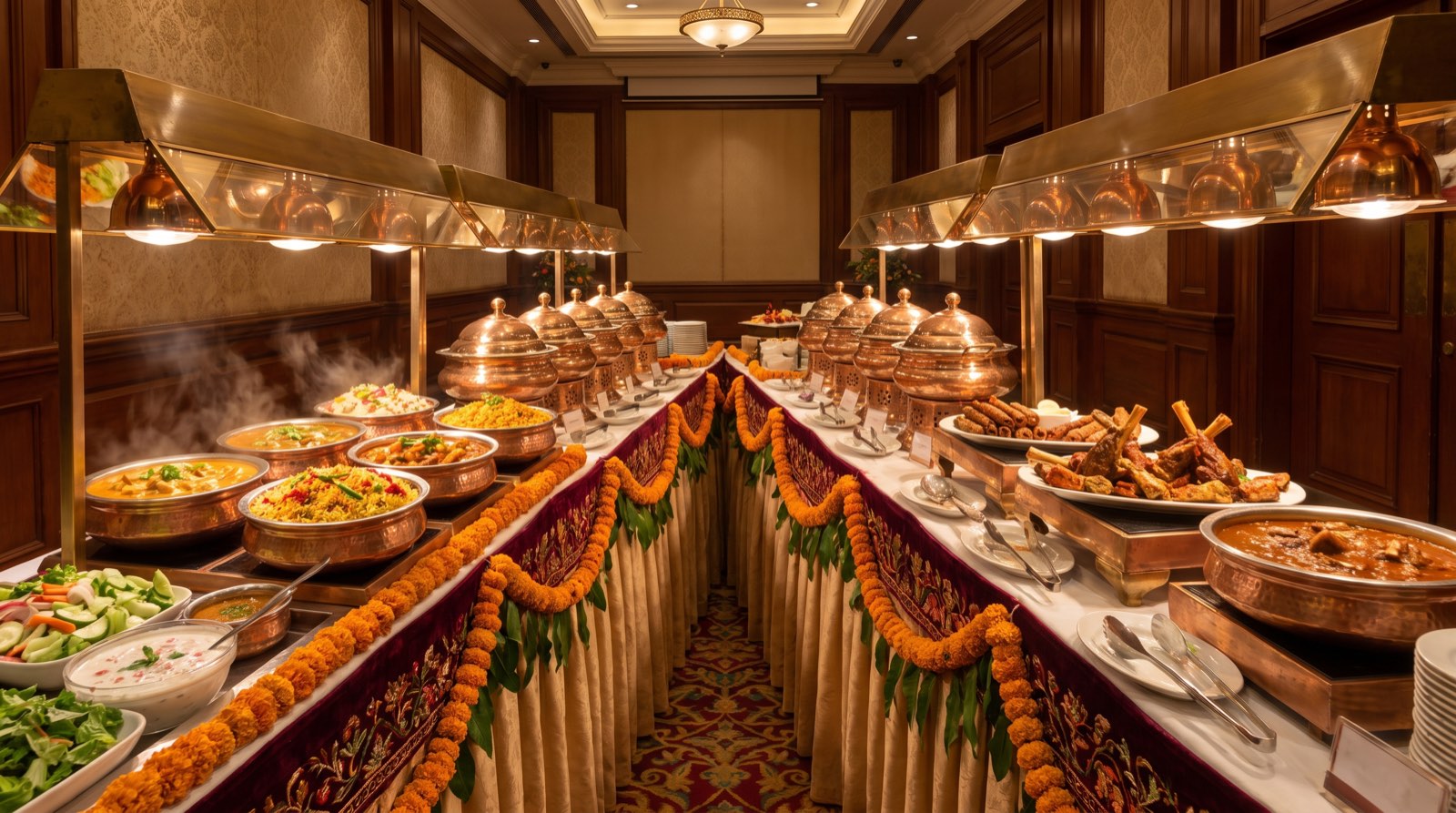
Serving both menus works when the lines are physically separate — different counters, servers, and clearly marked zones — with the veg line always first in the walking path. Non-veg plates cost ₹150–₹300 more than veg in Bengaluru (₹500–₹900 vs ₹350–₹600). Plan the split at roughly your guest ratio plus 10% extra veg.
Few menu decisions carry more social weight than veg versus non-veg. Done thoughtfully, both communities eat happily under one roof; done carelessly, someone’s grandmother goes home hungry on principle.
Here is the protocol that lets one wedding feed both worlds with total comfort.
The separation protocol
- Two fully separate buffet lines — separate counters, separate serving staff, separate crockery colour if possible; a shared line with “the non-veg at the end” satisfies nobody
- Veg line first along the natural walking path, clearly signed — strictly vegetarian guests should never have to walk past the biryani to reach the palya
- Ritual meals stay pure veg: the muhurtham lunch is traditionally sattvic; save the non-veg spread for the reception evening
- Ask the venue about kitchen policy — some halls are veg-only by principle; others, like most convention centres, run separate prep protocols. Never assume
The ratio and cost maths
| Menu | Bengaluru per-plate range | Planning note |
|---|---|---|
| Vegetarian (South Indian) | ₹350–₹600 | Base for muhurtham lunches and mixed crowds |
| Vegetarian premium (multi-cuisine) | ₹500–₹800 | Counters, salads, desserts widen the spread |
| Non-veg (chicken/mutton mains) | ₹500–₹900 | ₹150–₹300 over veg; biryani is the anchor |
| Seafood additions | +₹100–₹250 | Coastal menus; confirm cold-chain with caterer |
Order the split at your known guest ratio, then shift 10% toward veg — non-veg eaters happily eat vegetarian, never the reverse. For a 600-guest reception expecting a 60:40 non-veg lean, order 380 non-veg and 280 veg plates; the overlap absorbs surprises without waste.
Etiquette that guests silently grade
Label everything, including oils and stocks — “veg manchurian in shared fryer” is a real question your caterer should answer confidently. Give the veg line its own dessert and live counter so it never feels like the economy section. And brief the announcement: a simple “dinner is served — vegetarian to the left, non-vegetarian to the right” from the MC spares a thousand awkward peeks under chafing-dish lids.
Frequently asked questions
Can you serve both veg and non-veg at an Indian wedding?
How much more does non-veg wedding catering cost?
How do you decide the veg to non-veg plate ratio?
Planning an event? Talk to the team that hosts 200+ a year.
Check your date, walk the halls and taste the menu — no obligation. We respond within one working day.